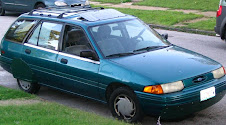
I made a trip to my friends' house yesterday and did about 85% highway driving with the air off, windows up, on my +5 psi tires. The 15% city miles I was very careful to EOC (engine off coast) as much as possible. It's getting very easy to predict when to shut off, by the way...
45.5 mpg may be a little inflated due to pump error, but it's indicative of some significant gains from my first tries at control tests. I'm going to run the next tank all the way down because I'm going to run some fuel system cleaner through at 5 gallons and then change the fuel filter. If things go right, and my aero mods (soon) are effective, I could break into the 500 mile/tank club next school year on my commute!
Friday, June 20, 2008

Sunday, June 15, 2008
City Mileage with Hypermiling
I've started doing modifications to my driving and the car; I decided it's best to do/build things now when I have time rather than reasons to drive, and then this fall do A-B-A tests and the like when I have a routine trip to make every day (to school) in order to get good data for this blog. This week, I'm going to start making aero mods and making them so that they can be undone for testing.
For my latest run, I hypermiled on 37 psi tires, and did 100% city driving with lots of stop lights and signs. I only used the a/c for about 5-10 miles, and the Gascort came up with 31.35 mpg. Not scientific data, but a good indication of what's in store for this fall!
For my latest run, I hypermiled on 37 psi tires, and did 100% city driving with lots of stop lights and signs. I only used the a/c for about 5-10 miles, and the Gascort came up with 31.35 mpg. Not scientific data, but a good indication of what's in store for this fall!
Thursday, June 12, 2008
Tire Pressure - Rolling Resistance relationship
Well, I went out with my new bike pump today to test out the effect of tire pressure on rolling resistance. Tire pressure for the first test was 32 psi, and for the second test, it was 37 psi. I used a big spring scale for measuring grain that I inherited from my grandpa, a Kansas farmer.
Either time, the force required to get the car to move was 58 pounds. I know flat tires make a car harder to push (enough to feel the difference), and I also know the top end should be less dramatic. I'm anxious to try pressure out when I'm back to making repeated trips to and from school every day, since there was no effect here.
Maybe there's another way to test this...
Either time, the force required to get the car to move was 58 pounds. I know flat tires make a car harder to push (enough to feel the difference), and I also know the top end should be less dramatic. I'm anxious to try pressure out when I'm back to making repeated trips to and from school every day, since there was no effect here.
Maybe there's another way to test this...
Wednesday, June 11, 2008
A surprise... better than expected!
This run was about 80% highway, more than before(50/50), but about 85% of it was with the air conditioning running, compared with 30% before. I'm very impressed and happy about the 34.5 mpg, but also worried about the large variance between the two "tanks" I've run so far, for the purpose of this experimentation. I knew this car's FE would react to little things easily,though - that's why I bought it. My Mustang never got lower than about 18 mpg when I ran the heck out of it, and never over 21 when I babied it. I think a little more time at factory settings might do me good, but I'm anxious to further my mods. I knew if worse came to worse, I could restart data collection next fall when I have a very regular and dependable commute to and from school, and do weekly trials with each mod separately. That will have to do, because Linda isn't going to let me turn the air off on her now!
For now, I'm going to bump tire pressure. I wanted to start hypermiling, but while I'm driving around a very pregnant wife, I don't want to do anything too oddball. The sidewall max on the tires is 35 psi; I'm going to set them at 37 - a nice, even 5 psi above factory settings. I think I'll work on calculating rolling resistance tomorrow.
For now, I'm going to bump tire pressure. I wanted to start hypermiling, but while I'm driving around a very pregnant wife, I don't want to do anything too oddball. The sidewall max on the tires is 35 psi; I'm going to set them at 37 - a nice, even 5 psi above factory settings. I think I'll work on calculating rolling resistance tomorrow.
A non- FE mod
In preparation for our baby (Linda's due July 1oth), I installed the car seat base today in the Gascort. I had trouble at first, because I couldn't get the base tight without having it tilt too far to the rear. I then decided to remove the seat back to see if it was advantageous to place the base farther toward the back of the seat cushion. Once the seat back was off, I got side-tracked and decided to install a LATCH bar like newer (2003+ model year) cars have.

Now I have the seat installed via the LATCH and the traditional seat belt. My baby's seat is not going to budge from that position.

Tuesday, June 10, 2008
Saving another type of fuel

I was cleaning out the kitchen today (still waiting for an excuse to drive the 'scort, so I figured I could clean and then take the recycling to our neighborhood drop-off) and I discovered that our "fat jar" had become full. For everyone out there who doesn't know what a fat jar is, allow me to edify. When you're cooking with ground beef and you drain off the fat, it's a bad idea to dump it down the drain. The fat cools and returns to its solid state as it transfers thermal energy to your pipes. You don't want too much in your arteries, and the same can be said for your drains. Some people claim that using hot water while dumping it helps, but that's a huge energy waste as well.
To avoid all this trouble, we keep a fat jar - just an empty glass jar that we dump the fat into. We typically put it in the refrigerator after dinner when it cools down, which keeps it solid and prevents it from smelling or spoiling (don't know if it would anyway).
Anyhow, if you've ever done calorimetry of foods in a chemistry or biology class, you know that the bonds in food store lots of energy, and this can be released by combustion into lots of thermal energy and light. This got me to thinking, my grandmother used to burn oil lanterns in her cabin, and she always reminded us kids that they used to get oil for those from whale blubber. Now, I ask, is cow fat much different from whale fat? After trying it out, I think not!
Fats (lipids) have ~9 calories per gram, while carbohydrates and protein have 4 cal/g and alcohol has 7 calories per gram. My fat should be capable of releasing more energy than an equivalent mass of alcohol, and hopefully it won't end up like a molotov cocktail...
I stuck a birthday cake candle into the top of the fat and it burned like this for 30 minutes, without appreciably dropping the fat level. This is definitely something I'm going to start saving for the "just in case" scenario. ;)

Monday, June 9, 2008
Wiring Behind the Dash


Subscribe to:
Posts (Atom)